
This event is strategically aligned with the International Year of Rangelands and Pastoralists (IYRP), the International Year of the Woman Farmer (IYWF), and follow-up actions to the International Year of Camelids 2024 (IYC 2024).
The MSP will build momentum for policy-relevant engagement, innovation, and investment-oriented discussions while strengthening GASL’s contribution to global policy processes.
Sustainable livestock development sits at the intersection of multiple global and regional megatrends that are especially visible in Senegal, West Africa and the wider Sahel. Climate change, rapid population growth, urbanisation, and shifting food demand are increasing pressure on land, water, and rangelands, while land degradation and climate variability threaten the resilience of pastoral and agropastoral systems. At the same time, livestock remains a cornerstone of food security, nutrition, livelihoods, and cultural identity, with particular importance for vulnerable groups such as pregnant women and young children, for whom access to animal-source foods is critical to improved nutrition and health outcomes.
Livestock Production Systems – Webinar
Livestock production systems are at the centre of the global response to climate change. While they are crucial for food security, nutrition, and livelihoods in low- and middle-income countries, they are also highly vulnerable to climate impacts and contribute to greenhouse gas emissions.
How do we navigate these complex trade-offs?
A key part of the solution lies in Animal Genetic Resources (AnGR). There will be a joint ILRI-FAO webinar on Wednesday, 10th June 2026 which will explore how sustainable management and strategic breeding can enhance livestock adaptation to climate extremes while contributing to mitigation efforts.
Join the discussion online Zoom Webinar 2:00 PM – 4:00 PM EAT, Meeting ID: 982 8025 8179 | Passcode: 56906826.
Livestock Biodiversity – Side Event
At a side event on Thursday, 11th June 2026, “Completing the Plate: Why livestock biodiversity matters for nature-positive food systems”, International Livestock Research Institute (ILRI), the Centre for Tropical Livestock Genetics and Health (CTLGH), the African Group of Negotiators, and partners will explore how livestock biodiversity in rangeland systems is central – not peripheral- to achieving climate resilience, ecosystem health, and sustainable food systems.
Christian Keambou Tiambo, scientist at the Centre for Tropical Livestock Genetics and Health (CTLGH) at the International Livestock Research Institute (ILRI), will share insights on a critical gap: the fragmentation between UNCCD and CBD–KMGBF approaches.
Challenges:
- In Global Dialogues, Land (UNCCD), biodiversity (CBD), and livestock systems are still treated as separate domains
- This leads to fragmented policies, uncoordinated financing, and missed opportunities for local action and impact
Yet, in reality, rangelands, Local and Indigenous livestock biodiversity, and pastoral livelihoods are deeply interconnected systems.
Join the presentation “Why do Global Frameworks still struggle to connect land, biodiversity, and livestock?” on 11th June from 3.10 PM to 4:10 PM.
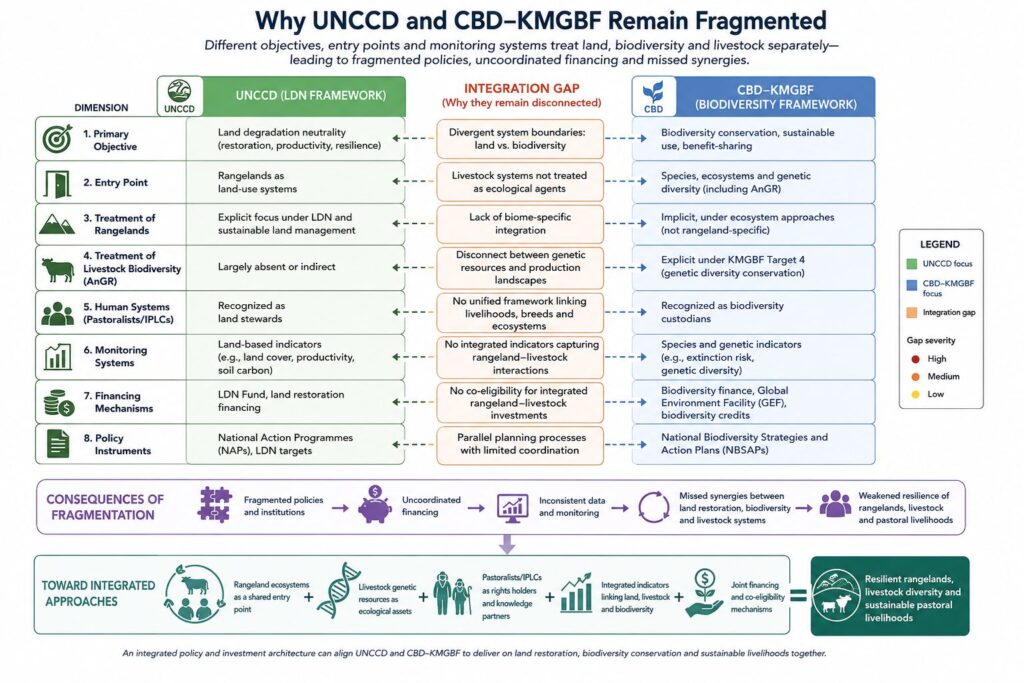 This figure outlines the main point of the talk by Christian K. Tiambo.